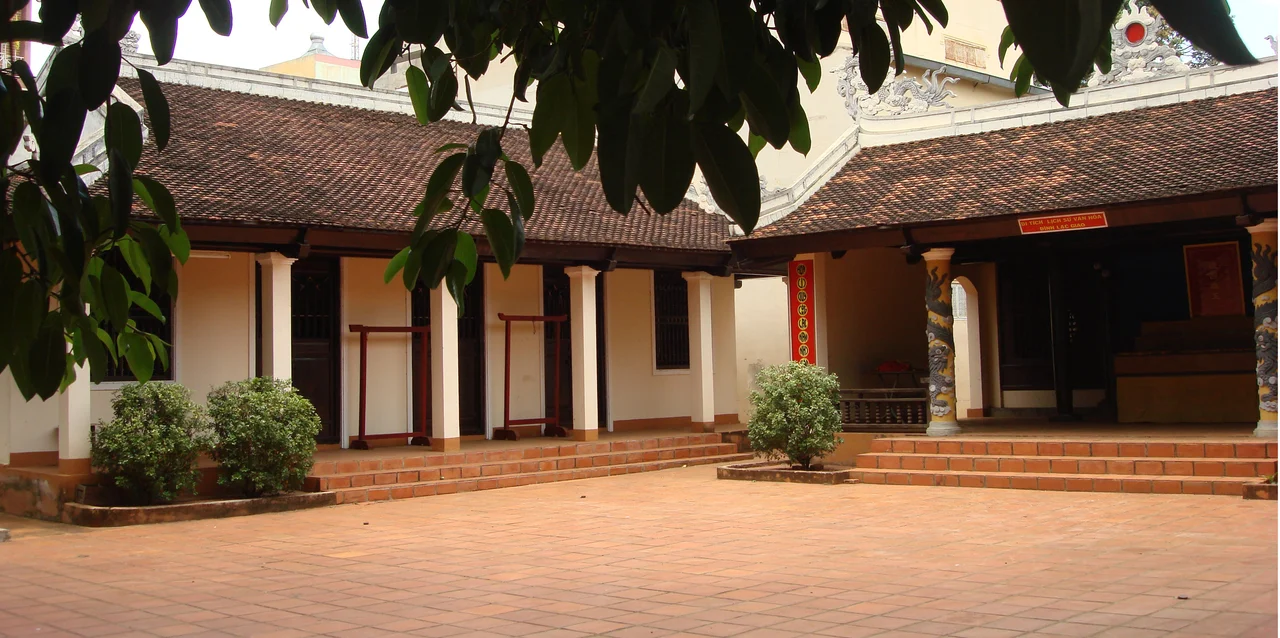

Đình Lạc Giao
Look up inside the main hall and the ridge beam carries its own record: characters cut into the wood marking the year the building went up and the years it was repaired since. The đình keeps its logbook overhead. It began in 1928, when a man named Phan Hộ and ten Kinh households from coastal Khánh Hòa came up onto the basalt plateau to clear land and founded a village they called Lạc Giao. Buôn Ma Thuột had been a French provincial seat for barely a quarter of a century. The settlers were newcomers twice over — strangers to the highlands, and a lowland people in Ê Đê country — and the first substantial thing they built together was not a market or a school. It was a communal house.
The Decree and the Founder
A đình is where a Vietnamese village keeps its guardian. The Nguyễn court issued a decree naming Đào Duy Từ (1572–1634), the scholar and strategist who served the Nguyễn lords, as the tutelary deity of Lạc Giao, and that piece of imperial paper mattered: it meant a village on the far edge of the uplands had been formally acknowledged by the dynasty. The first structure was modest, a place to gather. In 1932 the community rebuilt it properly, in brick under a tiled roof, fixing the plan and the ritual order that still stand today. Phan Hộ is honoured in a hall of his own as tiền hiền, the founding elder who opened the land. A third altar holds the Hùng Kings, the legendary first sovereigns of the Vietnamese. Guardian, founder, ancestors — three claims of belonging, made in wood and gold lacquer by people who had arrived four years earlier with almost nothing.
Built in the Shape of a Gate
The compound follows the plan Vietnamese builders call chữ môn, after the character 門, meaning gate. Roughly seven hundred square metres of ground hold a main hall of about a hundred, with everything else arranged around it in strict sequence: a triple gateway, then a spirit screen bearing a relief of the hổ phù mask and a heavy incense burner, then the courtyard, the sanctuary and the rear hall, with flanking wings on either side. Walls of brick, doors of wood, a roof of scallop tile. Along the ridge run paired dragons, the four sacred creatures and the four noble plants, with cloud scrolls banding the eaves. Inside, gilded lacquer boards read Lạc Giao đình and Hiển linh cảm ứng — roughly, the spirit is manifest and it answers. Two gates open onto Phan Bội Châu and Điện Biên Phủ streets, and the traffic of a working provincial city runs past both.
The Twenty-Seventh Day of the Tenth Month
In August 1945 the đình was where local revolutionaries gathered. That autumn French forces were moving back into highlands they had governed before the Japanese occupation, and on the night of 1 December 1945 a massacre took place in the centre of Buôn Ma Thuột. Those killed are remembered here as one hundred Nam tiến soldiers — young volunteers who had marched south to fight, most of them strangers to the town — together with residents of Lạc Giao itself. The memorial falls each year on the twenty-seventh day of the tenth lunar month, the date the killings occupy in the calendar the village actually keeps. It is worth pausing on what that means. Many of the dead had no family within hundreds of kilometres. They were mourned by a settlement seventeen years old, and that settlement has kept the anniversary for eight decades.
Bombed and Still Standing
The building came through the war intact, which is not the same as untouched: it was bombed and did not fall. When Buôn Ma Thuột was taken in March 1975 — the battle that opened the campaign ending the war seven weeks later — the incoming Military Management Committee held its inauguration here on 17 and 18 March, declaring that authority had passed to the people. A communal house raised by settlers under an imperial decree became the address where a new government introduced itself. On 2 March 1990 the Ministry of Culture and Information listed the đình as a national historical relic under Decision 168-VHQĐ. In 2005 the province undertook a major restoration, working from the recollections of local elders to recover carving and ornament that decades of use had worn thin.
Two Calendars in One Courtyard
The ritual year runs on the moon. The spring rite comes on the seventeenth day of the first lunar month and the autumn rite on the seventeenth of the eighth, both asking for kind weather and a quiet country. Since 2010 the đình has also hosted Đắk Lắk's provincial commemoration of the Hùng Kings on the tenth day of the third month, after soil, water and incense ash were carried here from the Hùng Temple in the northern midlands and installed on the altar — a deliberate transplant of the national origin story onto highland ground. Lion and dragon dancers fill the courtyard; teams wrap and steam sticky rice cakes to offer. The Đắk Lắk Museum helps manage the site, which the province presents as a "red address" for teaching revolutionary history. Shrine, memorial and classroom, all inside the same low brick walls.
From the Air
Đình Lạc Giao stands at 12.683°N, 108.041°E, at 67 Phan Bội Châu Street in the centre of Buôn Ma Thuột, on a basalt plateau roughly 500 metres above sea level. From the air the city reads as a dense red-roofed grid surrounded on all sides by the dark green corduroy of coffee and rubber estates — the đình itself is a small tiled courtyard compound in the old core and needs a low pass to pick out, ideally 1,500 to 2,500 feet AGL. Buôn Ma Thuột Airport (VVBM) lies just east of the city. Pleiku (VVPK) is the nearest alternate to the north. The dry season from November to April gives the clearest air; the May-to-October monsoon brings afternoon build-ups and low cloud over the plateau.
Nearby Stories
- Lak Lake 10 km away
- Dak Dam 20 km away
- Phước Bình National Park 47 km away
- Sen Monorom 53 km away
- Operation Van Buren 60 km away
- 22nd Division (South Vietnam) 71 km away
- Operation Nathan Hale 74 km away
- Lake Yeak Laom 101 km away