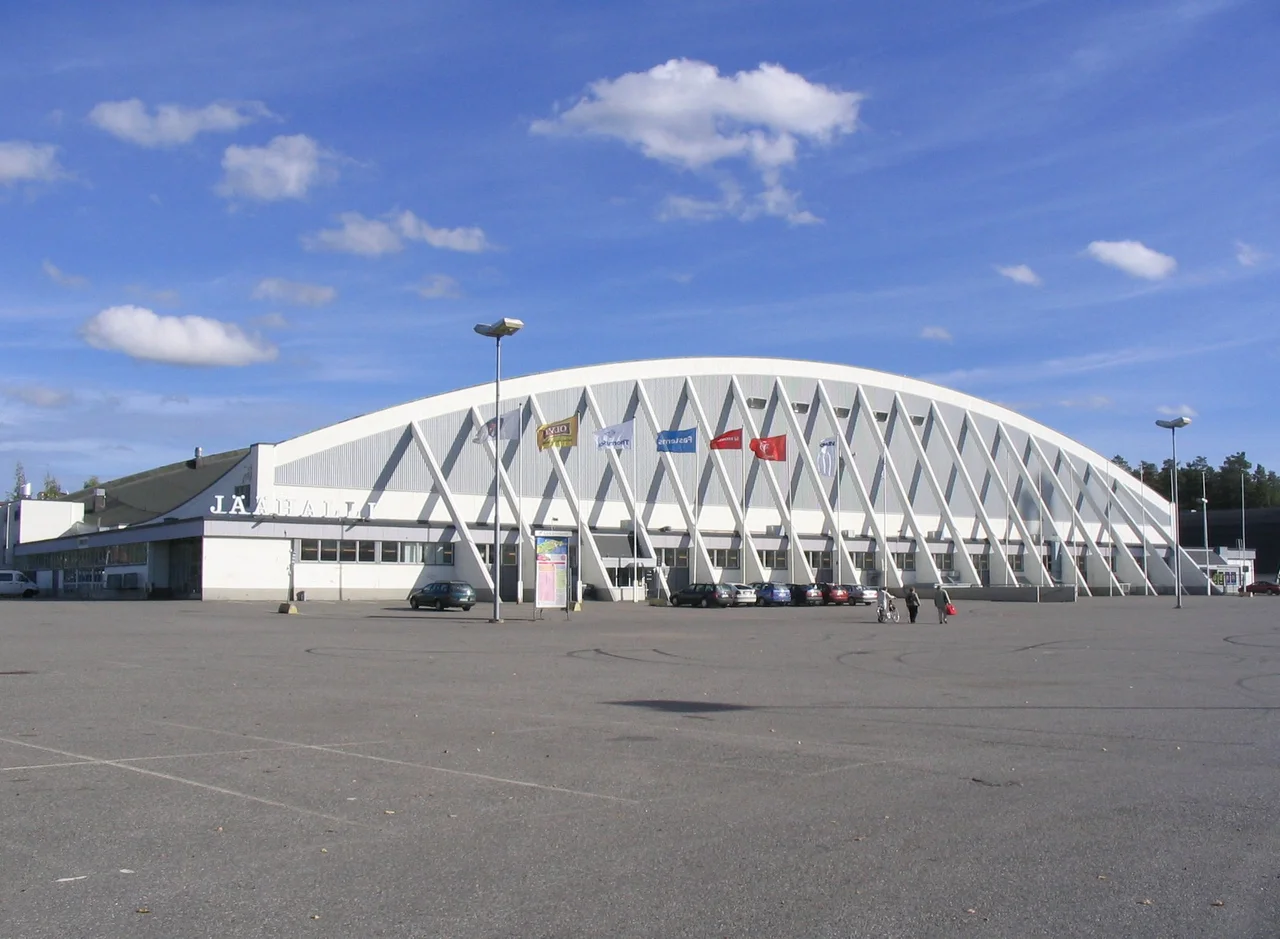

Tampere Ice Stadium
For fifty-six years, the best hockey in Finland was played in a low concrete box in a suburb called Hakametsä, out past the ring road, surrounded by pine woods and car parks. Ilves played there. Tappara played there. They played each other there, several times a season, in front of crowds that had been coming since their grandfathers' day. Then in November 2021 both clubs finished their last games, packed up their dressing rooms and moved about three kilometres west into a new downtown arena with a corporate name. The old building is still standing, still making ice, still hosting hockey - just not the kind that fills it.
The Twenty-Ninth of January, 1965
Jaakko Tähtinen designed the hall, and it was built for the World Championships that Finland hosted that spring. It opened on 29 January 1965 with an all-star game: Tampere against the rest of Finland, which ended tied at four. Two days later Ilves and Tappara met in the first league game played there, and Ilves won 5-3. The original capacity was 10,200 - a number that sounds impossible until you learn that only 1,573 of those places were seats. Everyone else stood, in coats, in a building that was cold by design. It was the first proper indoor ice hockey arena in the country, and for a sport that had spent decades on outdoor rinks at the mercy of a Finnish February, that mattered enormously.
Two Clubs, One Roof
Sharing a building with your fiercest rival is an unusual arrangement, and Ilves and Tappara did it for over half a century. Both clubs kept fan shops and VIP rooms in the same concourse. Both hung their retired numbers from the same ceiling. Tappara's side carried Kalevi Numminen, Pekka Marjamäki, Timo Jutila, Janne Ojanen and Timo Susi; Ilves answered with Aarne Honkavaara, Risto Jalo, Lasse Oksanen, Jorma Peltonen, Jukka Tammi and Raimo Helminen, who played in six Olympic tournaments. The third club, Koovee, came and went and came back. When a Tampere derby was on, the queue outside stretched into the trees and the noise inside had nowhere to escape.
Number 2
One banner belongs to a player who barely got to use the building. Jarmo Wasama was a 22-year-old Ilves defenceman, an Olympian at the 1964 Games, good enough that Finns still argue he might have become their country's first NHL player. On 2 February 1966 he was driving home from practice in thick fog when his car struck a stalled tractor. He died at the scene. His father, himself a former Ilves player, was in the car and survived. Ilves retired his number 2 immediately - one of the first retired jerseys in Finnish hockey - and the trophy given each year to the best rookie in the league carries his name. Sixty years on, the honour has outlasted almost everyone who saw him play.
A Room Built for Noise
The stands are stubbornly rectangular: a single main tier with an overhanging balcony down the western side, twenty suites and the press facilities opposite, standing places wedged into the corners. Most seats are padded now, though bare plastic survives up on the balcony. When a video cube was hung in 2007, it turned out the balcony blocked the view from the highest rows, so televisions were bolted underneath it to mirror the screen - the kind of improvised fix that gives an old building its character. Capacity settled at 7,300. Beyond hockey, the hall has hosted European and world championships in boxing, wrestling, judo and karate, international volleyball, and decades of concerts. It served as an IIHF World Championship venue in 1982, 1991, 1997 and 2003, and hosted the women's world championship in 1992.
What Happens to a Cathedral
Plans for a modern arena circulated through the late 1990s and early 2000s and went nowhere. The city council finally approved one in May 2010, and the Nokia Arena opened on 3 December 2021 - roughly €124 million, around 12,700 seats for hockey, built over the railway lines in the middle of town. It hosted the world championships in 2022 and again in 2023. Hakametsä, meanwhile, is being reworked into a sports campus, with Koovee on the ice and youth teams filling the hours. There is a particular quiet in a big old arena on a weekday afternoon, when the seats are empty and a dozen teenagers are running drills at one end. Fifty-six years of Finnish hockey started in this room. It has not finished being useful.
From the Air
Tampere Ice Stadium stands at 61.4958°N, 23.8242°E in the Hakametsä district, about 4 km east of central Tampere and just north of the Highway 12 corridor. From the air it reads as a long, low, pale-roofed hall with two smaller ice halls beside it, set in pine woodland and surrounded by open parking - an easy fix when approaching Tampere from the east. Lake Näsijärvi lies immediately north; the 168-metre Näsinneula tower marks the city centre to the west. Tampere-Pirkkala Airport (EFTP) is approximately 17 km southwest; Helsinki-Vantaa (EFHK) about 160 km south. Recommended viewing altitude 1,500-2,500 ft AGL. Winter approaches bring snow showers, low ceilings and very short daylight; the surrounding woodland makes the complex hardest to pick out under fresh snow cover.
Nearby Stories
- Akaa 7.4 km away
- Ikaalinen 11 km away
- Battle of Pälkäne 11 km away
- St. Olaf's Church, Tyrvää 17 km away
- The Artillery Museum of Finland 21 km away
- Church of Loimaa Proper 35 km away
- Helvetinjärvi National Park 38 km away
- Petajavesi Old Church 78 km away