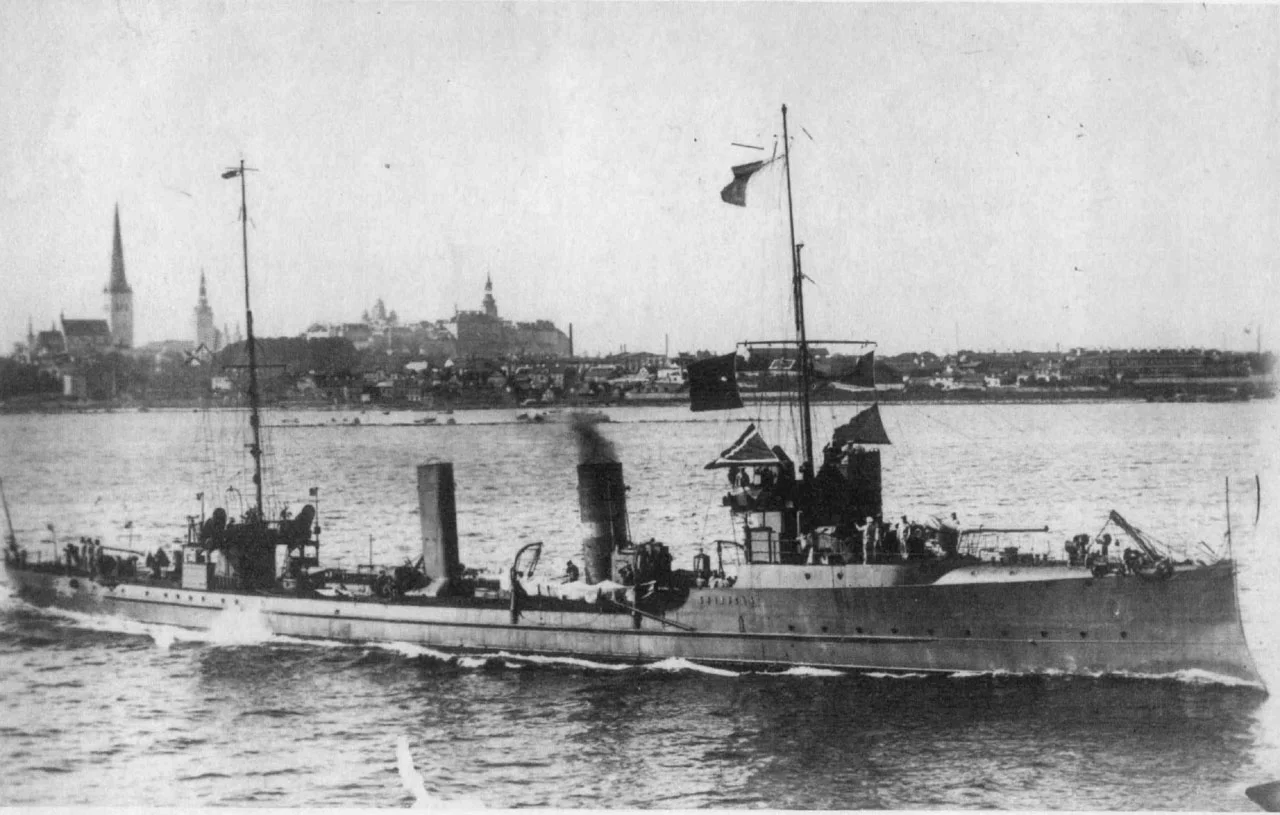

Russian destroyer Kazanets
Two dates mark the end of the destroyer Kazanets, and they sit thirteen days apart. Russian records give 15 October 1916. German records give 28 October. Both are correct. The Russian Empire still kept the Julian calendar that autumn, running just under two weeks behind the rest of Europe, so a ship could be lost twice on paper and only once in the water. She went down near the mouth of the Gulf of Finland, a few kilometres southeast of the low limestone island that Estonians call Osmussaar and Estonian Swedes called Odensholm - a stretch of sea her builders would have known well, because they built her a day's steaming away.
A Baltic Ship in the Fullest Sense
Lange & Sohn laid her keel in 1904 at their shipyard in Riga, then a city of the Russian Empire's Governorate of Livonia and now the capital of Latvia. She was launched on 28 April 1905 and completed on 3 May 1906. Seven sisters came off the same slipways - the whole eight-ship Ukraina class was a single yard's work, an unusual thing even then. Kazanets served her entire career in the sea she had been built beside, and among those eight she is the only one the Imperial Russian Navy lost to enemy action. The others were remarkably durable. Voiskovoy was not broken up until 1958; Turkmenets-Stavropolsky lasted until 1962; the name ship, Ukraina, was finally expended as a gunnery target in July 1961, more than half a century after she left Riga.
Seventy-Three Metres of Narrow Hull
She was a small ship built around a single quality. Displacing 580 tonnes normally and 732 at full load, she measured 73.18 metres long with a beam of just 7.21 metres - a hull roughly ten times longer than it was wide, drawn out like a blade. Her draft of 3.35 metres suited the shoal-strewn Gulf of Finland, where a deeper ship has fewer choices. Two four-cylinder vertical triple-expansion steam engines drove one shaft apiece, fed by four Normand boilers, and the design called for 25 knots. On trials she beat it, touching 25.6. Ninety officers and men lived inside that narrow tube of steel, sharing the noise, the coal smoke and the roll that a hull of those proportions produces in any weather at all.
The Guns Changed; the Ship Did Not
As completed, Kazanets carried two 50-calibre 75 mm guns, one forward on the forecastle and one aft, backed by four 57 mm guns on the main deck amidships, two to a broadside. Every gun had a shield - thin protection, but protection. Three 380 mm torpedo tubes sat in two rotating mounts, a twin between the middle and after funnels and a single further aft. In 1909 and 1910 the class was rearmed. The 75 mm guns gave way to a pair of 102 mm Pattern 1911 Obukhov guns, and the 57 mm battery was removed outright. Fewer barrels, heavier shells: the Baltic Fleet was rebuilding itself in those years after catastrophic losses in the war with Japan, and it had learned that a destroyer needed range and weight more than it needed a hedge of small guns.
A Narrow Sea, Thoroughly Mined
By 1916 the Gulf of Finland had become one of the most heavily contested corridors in Europe - a shallow, island-choked funnel that both navies filled with mines and patrolled with everything they had. Into that water came UC-27, a German Type UC II submarine launched on 28 June 1916 and commissioned on 25 July, purpose-built to lay mines from tubes in her bow. She joined the Baltic Flotilla in September 1916 under Oberleutnant zur See Karl Vesper. Within weeks she had accounted for Kazanets. UC-27 went on to a long and busy war in the Mediterranean, at one point commanded by Wilhelm Canaris, and survived to be handed over to France in 1919 and scrapped at Landerneau in 1921.
Ninety Men and a Set of Coordinates
What is recorded about Kazanets is oddly lopsided. Her beam is given to the centimetre and her trial speed to a tenth of a knot, while her crew appears as a single round number - ninety - and what became of those men on the day she sank has not carried through into the English-language record at all. They were Baltic Fleet sailors in the third year of a war their empire would not survive; within thirteen months of her loss, the navy that owned her had ceased to exist in the form she served. Today her position is a point on a chart at roughly 59.26 degrees north, 23.49 degrees east, in the pale green water off Osmussaar. The island above her has its own long memory of ships that did not make it past: its people once lived partly on what the sea delivered to their shore.
From the Air
Wreck position approximately 59.26 N, 23.49 E, in the Gulf of Finland off the southeastern shore of Osmussaar, Estonia. Best viewed from 3,000-5,000 ft, where the shallow banks around Osmussaar and Neugrund show as distinct pale green shoals against the darker open Baltic. Osmussaar itself is unmistakable: a flat limestone slab about 5 km long with a black-and-white banded lighthouse at its northwestern end. Nearest airfields are Amari (EEEI) about 45 km southeast, Tallinn Lennart Meri (EETN) about 80 km east, and Kardla on Hiiumaa (EEKA) about 60 km southwest; Helsinki-Vantaa (EFHK) lies roughly 90 km north across the gulf. Sea haze and low stratus are common here from October through March - the same conditions that made this water so dangerous in 1916.
Nearby Stories
- Russian cruiser Pallada (1906) 2.8 km away
- Haapsalu Castle 16 km away
- Padise Abbey 17 km away
- Finnish minelayer Louhi 19 km away
- Koluvere Castle 21 km away
- Hitis 66 km away
- Saaremaa 75 km away
- Military Museum of Finland 87 km away