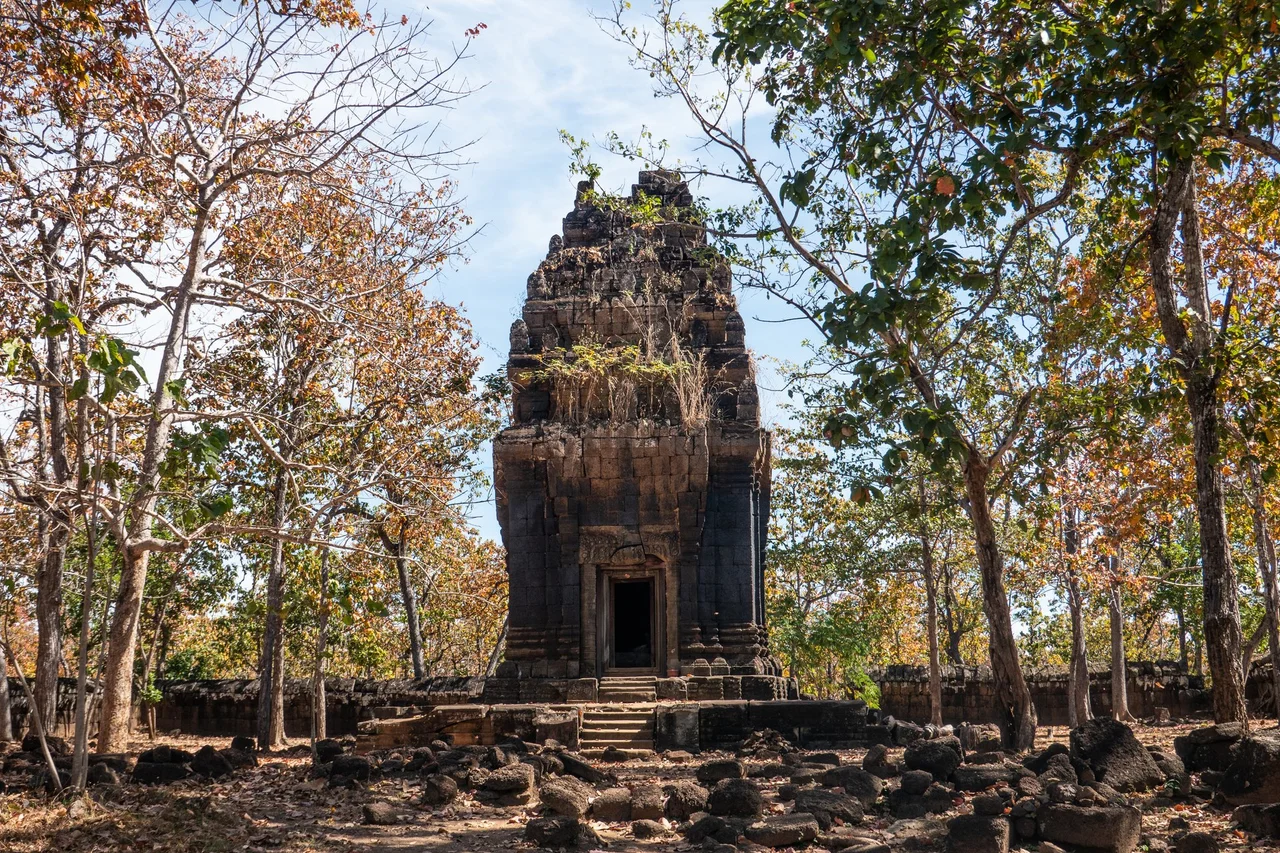

Koh Ker
The pedestals are still there. Set into the floor of Prasat Chen, drilled with the sockets that once held the pins anchoring bronze and stone, they mark where a group of warriors stood locked in combat for a thousand years - and where, during Cambodia's war decades, someone cut them off at the ankles. The feet stayed. The bodies went to New York, to Pasadena, to private living rooms on three continents. Koh Ker was the capital of the Khmer Empire for sixteen years, and in that time its workshops produced some of the most violently alive sculpture ever carved in Southeast Asia. For most of the last half-century, the easiest place to look at that sculpture was an auction catalogue.
Sixteen Years of Capital
Jayavarman IV ruled from Koh Ker between 928 and 941 CE, and his successor Harshavarman II held the court here until 944. Why a Khmer king would leave the fat, well-watered plains north of the Tonle Sap for this dry scrubland is still argued over. He may have been a usurper who needed his own ground; he may simply have been going home, since the evidence suggests he was a local lord here before he was king of anything. Ancient inscriptions call the place Lingapura, the city of lingas. Those same inscriptions record how the building program was paid for: a taxation regime so aggressive that the scribes thought it worth writing down. Within the 81 square kilometres now protected, archaeologists count 184 monuments. After 944 the court went back to the plains, and no Khmer king ever ruled from here again.
The Prang
Almost every Khmer state temple is concentric - you spiral inward through nested enclosures toward a centre. Prasat Thom does not. Its plan runs in a straight line east to west, a procession rather than a spiral, and at the end of it stands the Prang: a seven-tiered sandstone and laterite pyramid, 62 metres to a side at the base and 36 metres tall. A single colossal linga once crowned the summit, reportedly more than four metres high, and it is gone like nearly everything else portable at this site. East of the temple lies the Rahal, a reservoir roughly 1,200 metres long and 560 metres wide, its banks stepped with laterite. The builders used brick, laterite and sandstone more or less interchangeably. A thousand years on, the small hard bricks have outlasted the stone.
Stone in Motion
What the Koh Ker workshops did with sandstone has no real precedent. UNESCO's citation reaches for the word motion, and that is the right word: figures caught mid-lunge, weight already shifted, muscle bunched for a blow that never lands. The masterpiece was a group from Prasat Chen showing Bhima and Duryodhana from the Mahabharata at the instant before the killing stroke, two heavy bodies leaning into each other across an open floor. Another pair showed the monkey kings Sugriva and Valin wrestling. The style was so distinct that art historians simply named it after the place. None of the great pieces are at Koh Ker now. Some are in the National Museum in Phnom Penh and the Musee Guimet in Paris. The rest were taken.
What Came Back
The statues left Koh Ker in a country that had no functioning economy, no police worth the name, and a great many people with nothing. The men who did the physical work of cutting a two-tonne sculpture off its base were mostly Cambodians who saw a tiny fraction of what the piece would eventually sell for; the money accumulated much further down the chain, among dealers and collectors who paid seven figures and asked remarkably few questions about provenance. Reversing that took decades and lawyers. When Sotheby's offered the Duryodhana at auction in late 2011, the Cambodian and United States governments filed in March 2012 to seize it, and the warrior went home in December 2013. The Metropolitan Museum of Art had already returned its pair of Kneeling Attendants in May of that year. The Norton Simon Museum in Pasadena sent back Bhima in 2014, and the two fighters finally faced each other again in Phnom Penh.
The Quiet Site
On 17 September 2023, at the extended 45th session of the World Heritage Committee in Riyadh, Koh Ker was inscribed on the World Heritage List as "Koh Ker: Archaeological Site of Ancient Lingapura or Chok Gargyar" - Cambodia's fourth World Heritage property. It has not become Angkor. There are no crowds, no hotel strip, a village of stilted houses and a primary school about a kilometre from the main sanctuary, and two open-air restaurants by the parking area where you can get noodle soup and cold coconut. Roughly two dozen of the 184 monuments are open. The rest are in forest that has been swept for mines only along the roads and the ring road, which is why the danger signs stand where they do. Stay on the cleared ground and the loudest thing at Koh Ker is the wind in the trees.
From the Air
Koh Ker sits at 13.783 N, 104.533 E on the low northern plain of Cambodia, about 120 km northeast of Siem Reap in sparsely settled country. From 2,000-4,000 ft AGL the giveaway is not the pyramid but the Rahal - a hard-edged rectangular reservoir roughly 1,200 by 560 metres, an unnatural geometry in an otherwise ragged canopy. The Prang's stepped mass sits just west of it. The nearest major field is Siem Reap-Angkor International (VDSA); Phnom Penh International (VDPP) is the practical alternate. Best light is early dry season, November through February, when haze is low; from May onward monsoon convection builds fast over the northern plain in the afternoons, and the unpaved approach roads soften enough that ground access needs four-wheel drive.
Nearby Stories
- Phnom Thnout-Phnom Pok Wildlife Sanctuary 7.2 km away
- Angkor Thom 24 km away
- Stung Sen Dam 30 km away
- Cambodian Landmine Museum 32 km away
- Emerald Triangle (Southeast Asia) 32 km away
- Preah Vihear 38 km away
- Chinit River 79 km away
- Si Thep Historical Park 350 km away