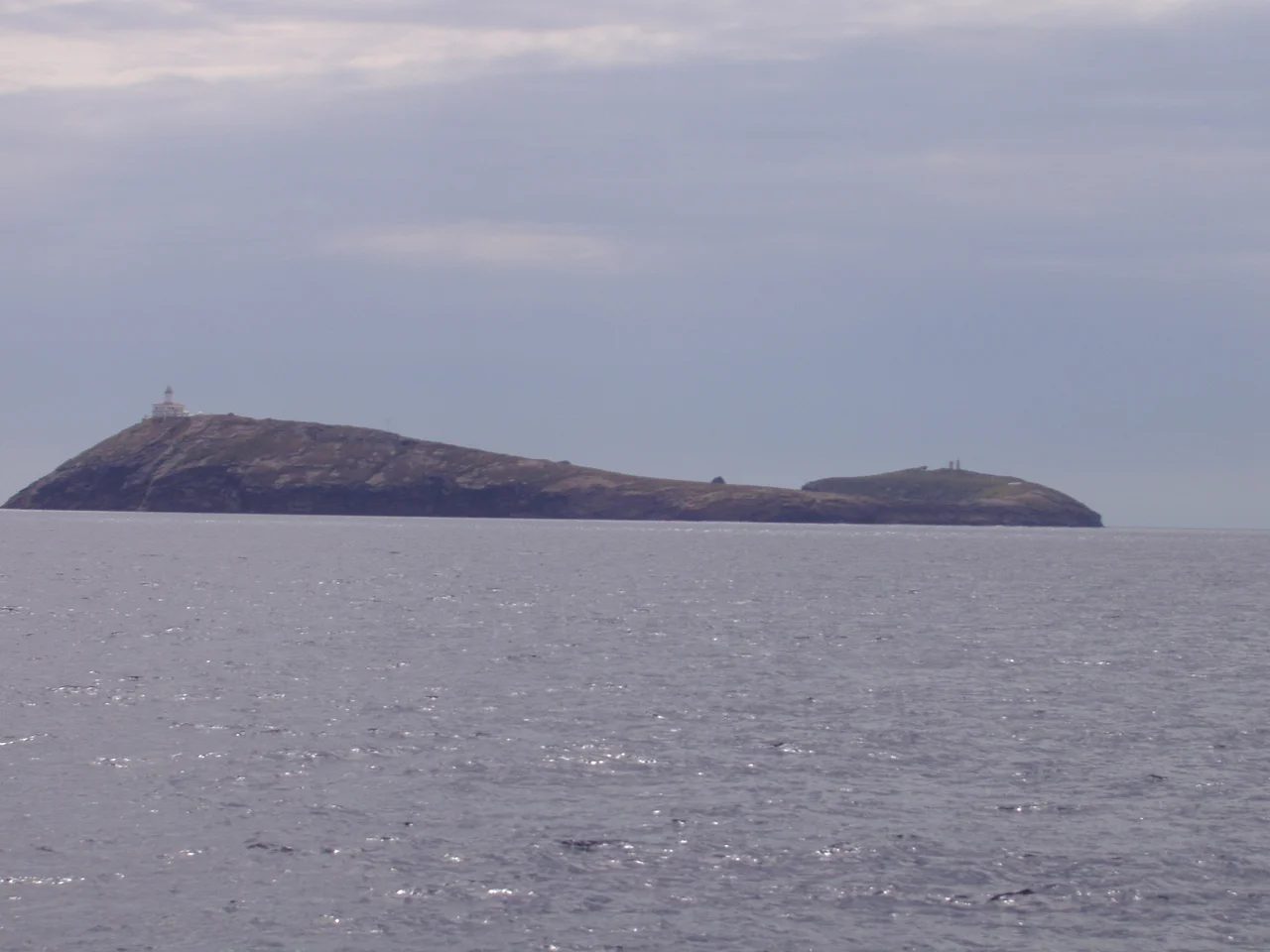

Illa Grossa
In the middle of the 19th century, someone decided the simplest way to deal with the snakes was to burn the whole island. Illa Grossa, the largest of the Columbretes archipelago, was so thick with reptiles that ancient Greek and Roman sailors had named the place for them, calling it Ophiusa and Columbraria. To make it fit for a lighthouse and its keepers, crews set the island alight and let the fire do its work on a population of snakes found nowhere else. It was an act of casual extermination that reads uneasily today, and it says everything about how remote and forbidding this speck of volcanic rock once seemed.
A Ring of Fire, Cooled
Illa Grossa is barely there at all, just fourteen hectares of land sitting some sixty kilometres out from the Costa del Azahar. Its shape gives away its origin: a half-ellipse about a kilometre across, curved like the rim of something enormous, because that is exactly what it is. The island is the exposed edge of old volcanic craters, built of dark basalt, its highest point the modest rise of Mount Colibrí at the northern end. Seen from above, the crescent of land cupping a flooded crater looks less like an island than like a piece of the sea floor that briefly forgot to sink.
The Light and the Naturalist
In 1859 a lighthouse was raised sixty-seven metres above the waves at the archipelago's highest point, and keepers came to live on a rock that offered them almost nothing. In 1895 the Austrian archduke and traveller Ludwig von Salvator published Columbretes, the first full account of the islands' plants and animals, turning a navigational hazard into a subject of science. For more than a century the lighthouse was tended by hand, its keepers among the most isolated people on the Spanish coast, until the light was automated in 1975 and the human presence dwindled to almost nothing.
Target Practice
The island's strangest chapter came in the late 1970s, when the Spanish and American navies used the Columbretes as targets, bombarding this fragment of unique habitat during military exercises. The shelling continued until 1982, when student protests pressed the provincial authorities of Castellón to demand a stop, and the Spanish defence ministry agreed. It is a small, telling story of changing values: a place once considered so worthless it could be set on fire and then shelled became, within a few years, something a public rose up to protect.
A Refuge Won Back
Protection came quickly once it came. The Columbretes were declared a natural park in 1988, ringed by a marine reserve of more than four thousand hectares in 1990, and reclassified as a natural reserve in 1994. Today no one lives here but the guards posted by the Valencian government, and the wildlife has the island largely to itself. The Columbretes lizard, Podarcis atrata, survives here and nowhere else, and the surrounding cliffs and waters shelter endangered birds including Eleonora's falcon and Audouin's gull. The snakes are gone, burned out of existence more than a century ago, but the island they once ruled has become one of the most carefully guarded scraps of land in the western Mediterranean.
A Haven in Open Water
Isolation is the making of the place. The flooded crater at the island's heart forms a near-enclosed cove, one of the only sheltered anchorages across a wide stretch of open sea, and that shelter long made the Columbretes a waypoint for anyone crossing this part of the Mediterranean. For wildlife the remoteness is a gift. Free of the predators and disturbance of the mainland, the cliffs and low scrub give nesting room to seabirds, among them Audouin's gull, one of the rarest gulls in the world, and Eleonora's falcon, a slender raptor that breeds unusually late in summer so it can feed its young on the songbirds streaming south overhead. In spring and autumn the island becomes a landfall for exhausted migrants crossing the sea. In little more than a century this speck of basalt has gone from a place to be burned and shelled to one of the most important refuges on the flyways of the western Mediterranean.
From the Air
Illa Grossa sits well offshore at 39.898°N, 0.685°E, about 60 km east of the Costa del Azahar, isolated in open Mediterranean water. From altitude it is an unmistakable waypoint: a small dark crescent of land almost enclosing a lagoon, with a lighthouse at its high point and no other land nearby. Its isolation makes it a clean visual and radar fix along coastal routes. The nearest mainland fields are Castellón-Costa Azahar (LECN) to the west-northwest and Valencia (LEVC) to the southwest, with Reus (LERS) farther up the coast. Overflight is constrained by the marine reserve's protections; visibility over open water is usually excellent but the island's small size rewards a known heading.
Nearby Stories
- Sanctuary of St. Paschal Baylon 16 km away
- Serra d'Irta Natural Park 28 km away
- El Cabanyal 30 km away
- Penyagolosa 34 km away
- Cala d'Albarca 61 km away
- City of Arts and Sciences 76 km away
- Cala Benirrás 88 km away
- Roman Theatre (Tarraco) 116 km away