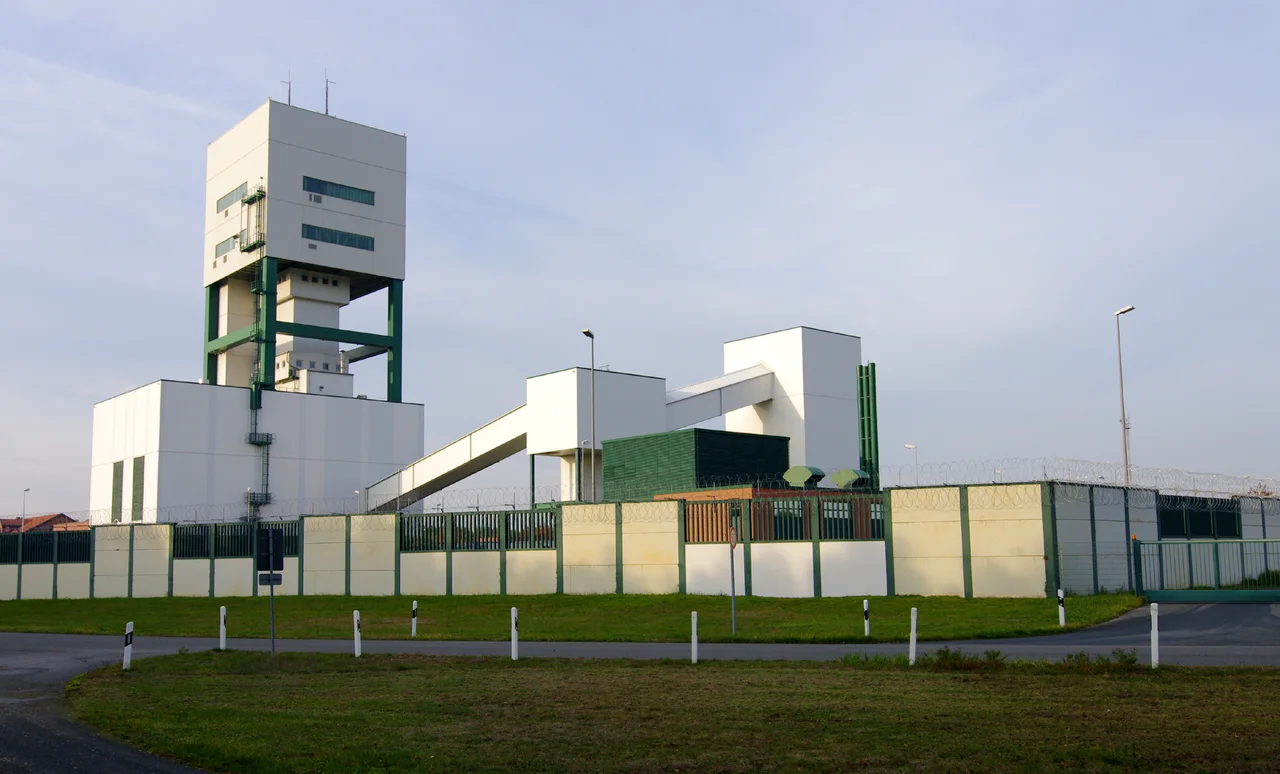

Gorleben
Two shafts go down into the salt below Gorleben. The deeper reaches 965 metres; the working level sits at 840. Between 1986 and 1996 they were sunk, connected and driven out into galleries, and by January 2024 the exploration had consumed at least 2.1 billion euros, ninety per cent of it paid by Germany's electricity companies. Nothing radioactive was ever put in them. On 28 September 2020 the federal agency responsible for final disposal struck the Gorleben salt dome from its list of candidate sites, and since late November 2024 contractors have been backfilling the whole thing with salt. It is one of the most expensive holes ever dug in Europe, and it is being deliberately erased.
Silt, or Mountain
Almost nobody lives here. The municipality had 614 residents at the end of 2024, in the Gartow corner of Lüchow-Dannenberg, in the far north-eastern tip of Lower Saxony — the district usually called the Wendland. Gorleben first appears in the records of the lords of Dannenberg in 1360, when there was a fort on the site. The name is probably Goor, meaning silt, joined to leben, meaning heritage, though in Slavic gor means mountain, which in this landscape would be a joke. The village sits on the left bank of the Elbe about twenty metres above sea level. River meadow spreads east, north and north-west, protected as a biosphere reserve. To the south stands the Gartower Tannen, the largest continuous privately owned forest in Germany, growing on hills of wind-blown sand and belonging to the Bernstorff family of Gartow.
Why Anyone Looked Here
The whole region lies inside the Elbe glacial valley, the great meltwater channel that drained the last Ice Age northwards, and the flatness is deceptive — the Höhbeck moraine rises out of it like a Pleistocene island, left behind by an earlier glaciation. Underneath is salt. Salt domes attracted planners across Europe because rock salt is dry, plastic enough to close its own cracks, and has demonstrably kept water out for geological spans of time. Exploratory drilling at Gorleben began in 1979 and continued, on and off, for twenty years. The industry originally wanted more than a repository: a reprocessing plant at Dragahn west of Dannenberg and a nuclear power station at Langendorf on the Elbe. Both were abandoned as impractical. What got built instead sits in woodland about two kilometres south-west of the village.
The Casks Above Ground
Four installations stand in those woods, and the one that matters most is the least dramatic to look at: a hall. The Transportbehälterlager Gorleben holds spent fuel elements and vitrified high-level waste in dry casks that stand on a floor and are cooled by nothing more elaborate than the surrounding air. Permission exists for 420 of them. Much of what they contain went to La Hague in France under contract for reprocessing, and the unusable remainder came back — because it had to. The first shipments arrived in April 1995, and the returns became the fixed point of the German anti-nuclear calendar. Castor transports ran by rail and heavy lorry through northern France and Germany, usually in November, shadowed by enormous police deployments. In November 2008 more than 15,000 people turned out to slow one down with tractors and sit-ins.
Ten Years of Not Digging
On 14 June 2000 the federal government and the energy suppliers agreed to stop. Exploration was suspended for a decade, from October 2000 to October 2010, while conceptual and safety questions were reconsidered — although the mine still had to be ventilated, pumped and maintained, at around 22 million euros a year, to keep it from collapsing on the argument. When Angela Merkel's government lifted the moratorium in 2010 and restarted the work, the protests restarted with it. By then the dispute had its own vocabulary and its own institutions, including the Gorleben-Gelder: annual compensation payments to the municipality and the Gartow administrative association, money that arrived precisely because the place had been chosen.
What the Overburden Could Not Do
The 2020 verdict did not turn on politics. Assessors concluded that the rock lying above the Gorleben salt dome — the overburden that has to keep groundwater away from the salt for a million years — was not thick or sound enough to be relied on. Salt dissolves. The cover was the weak link, and it had been the weak link all along, which is the uncomfortable finding after four decades of drilling. In September 2021 the environment ministry ordered the mine closed, and in late November 2024 the contractors began packing the galleries with salt. The casks in the hall above ground are still there, and will be for as long as it takes Germany to find somewhere else. The search continues. Gorleben, having given its name to the entire question, is no longer part of the answer.
From the Air
Gorleben lies at 53.048°N, 11.356°E, on the west bank of the Elbe in far north-eastern Lower Saxony. Best viewed at 2,000-4,000 ft AGL. The nuclear installations sit in forest roughly 2 km south-west of the village and are easy to identify from the air: large light-roofed halls in a fenced clearing, isolated from any settlement. Navigational anchors: the Elbe with its wide floodplain, which carried the inner-German border until 1990 and is now part of the Green Belt corridor; the Höhbeck rising out of the valley to the north-east; the dark block of the Gartower Tannen forest to the south. Nearest airports: Hamburg (EDDH) about 105 km north-west, Hannover (EDDV) about 120 km south-west, Berlin Brandenburg (EDDB) about 150 km south-east. The terrain is flat and obstacle-free; expect river haze and low cloud over the Elbe valley in autumn and winter.
Nearby Stories
- Ludwigslust Palace 8.1 km away
- Tangermünde 22 km away
- Gardelegen Massacre 22 km away
- Scharnebeck Twin Ship Lift 28 km away
- Ebstorf Abbey 33 km away
- Autostadt 35 km away
- Battle of Wittstock 40 km away
- Fusion Festival 52 km away