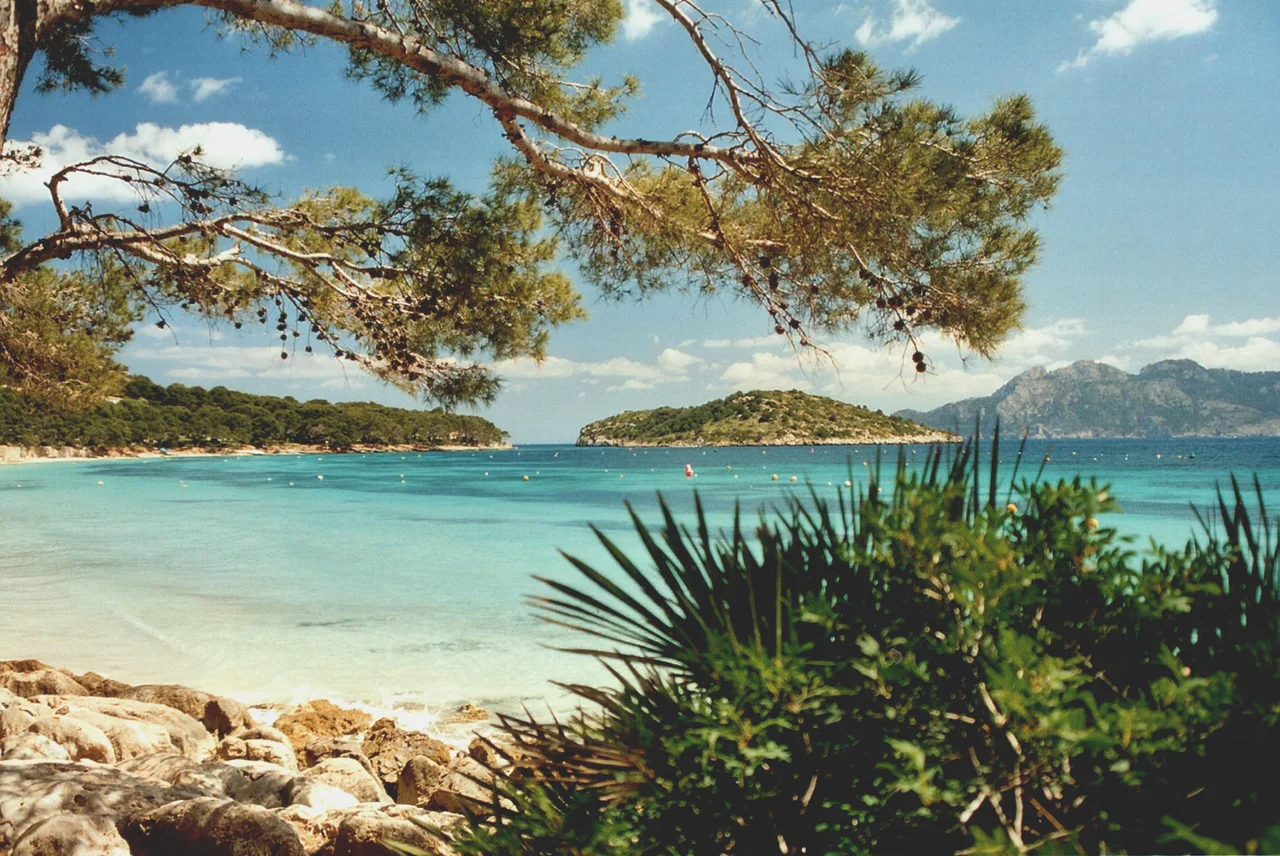

Cap de Formentor
The Mallorcans have a name for this cliff that says everything: the meeting point of the winds. Stand on the Cap de Formentor, the island's northernmost thrust of rock, and you feel the truth of it. Air currents that have run unbroken across the Mediterranean slam into the headland and rise, tearing at anything that dares stand upright. Below your boots the sea roars in the gap of 300 meters. This is where Mallorca ends, not with a beach but with a wall of stone, and generations of Mallorcans have understood it as a place of raw elements rather than gentle holiday.
The Meeting Point of the Winds
Formentor is a peninsula of knife-edge ridges and plunging drops, and its highest point, Fumat, rises 384 meters straight from the water. Wind is the constant here. It can turn vicious without warning, and the viewing points along the headland are not for anyone unsettled by heights, since the cliffs fall away hundreds of meters to a sea that never seems to rest. Yet the place is beautiful precisely because it is severe. Pale limestone catches the light, small hidden bays like Cala Figuera, Cala Murta, and Cala Pi de la Posada notch the coastline, and the whole peninsula feels like the bow of a ship pointed at open water.
A Road Carved by Hand
Reaching the tip used to mean a boat or a long walk. That changed in 1925, when the Mallorcan engineer Antonio Parietti threaded a 13.5 kilometer road from Port de Pollença out to the cape. Where the slope grew too steep, the road simply refused to give up, running oblique across the face and doubling back in switchbacks that hang over the drop. Parietti had a gift for this kind of impossible ribbon of tarmac; he also built the famous snake road down to Sa Calobra elsewhere on the island. Along the Formentor route, lookouts like the Mirador d'es Colomer, named for the small island of Colomer offshore, reward drivers who dare to glance away from the wheel.
The Poet's Peninsula
For a time the whole of Formentor belonged to a poet. Miquel Costa i Llobera, one of Mallorca's most revered writers, owned the peninsula and immortalized it in his famous poem The Pine of Formentor, casting a lone wind-bent tree as an emblem of endurance. After his death the land was divided into lots and sold, and in 1928 an Argentinian art lover named Adan Diehl bought in and built the Hotel Formentor. The grand hotel drew a glamorous crowd to this remote corner and helped turn a poet's private wilderness into one of the Mediterranean's storied addresses, though the wind and the cliffs never lost their edge.
The Lighthouse at the Edge
At the very tip stands the Formentor Lighthouse, lit in 1863. Building it was an ordeal. The location was so remote and rugged that materials could arrive only by sea or up a long mule track, and every stone had to be hauled to the end of the world and set against the wind. The reward is a panorama that few lighthouses can match. On a clear day the view sweeps to Menorca in the east, to Cala Figuera in the west, and south to Alcudia with its long sandy beach, the whole northern sea laid out from what Mallorcans call the island's Finisterre, its land's end.
The Cave Below the Cliffs
The drama is not only above the waterline. On the southeastern flank, near a spot called Racó de Xot, a sea cave opens into the rock with two mouths set about eight meters above the surface. Inside, the passage runs some 90 meters long and 8 meters high, a cathedral of shadow and echo carved by the sea. It is more than a curiosity for kayakers. The cave has proven to be one of the most important sources of information about the prehistoric talaiot culture that shaped these islands, a reminder that people were reading the moods of this headland thousands of years before any road or lighthouse arrived.
From the Air
Cap de Formentor sits at 39.9622 N, 3.2136 E, the northernmost point of Mallorca. Recommended viewing altitude is 3,000 to 5,000 feet, high enough to see the peninsula's full knife-edge spine and low enough to pick out the white lighthouse at the tip. Landmarks include the small island of Colomer just off the north shore, the sheer 300-meter cliffs, and the switchbacking road threading in from Port de Pollença. Palma de Mallorca airport (LEPA) is roughly 60 km southwest; Menorca airport (LEMH) lies east across open sea. Expect strong, gusty winds and mechanical turbulence near the headland; visibility is often superb but the cape generates its own local weather.
Nearby Stories
- Naveta d'Es Tudons 2.5 km away
- Alaró 2.9 km away
- Artà 3.6 km away
- Sa Calobra 16 km away
- Llobregat Delta 130 km away
- Montjuic Cemetery 158 km away
- Shipwreck of Dellys 313 km away
- Cosquer Cave 353 km away