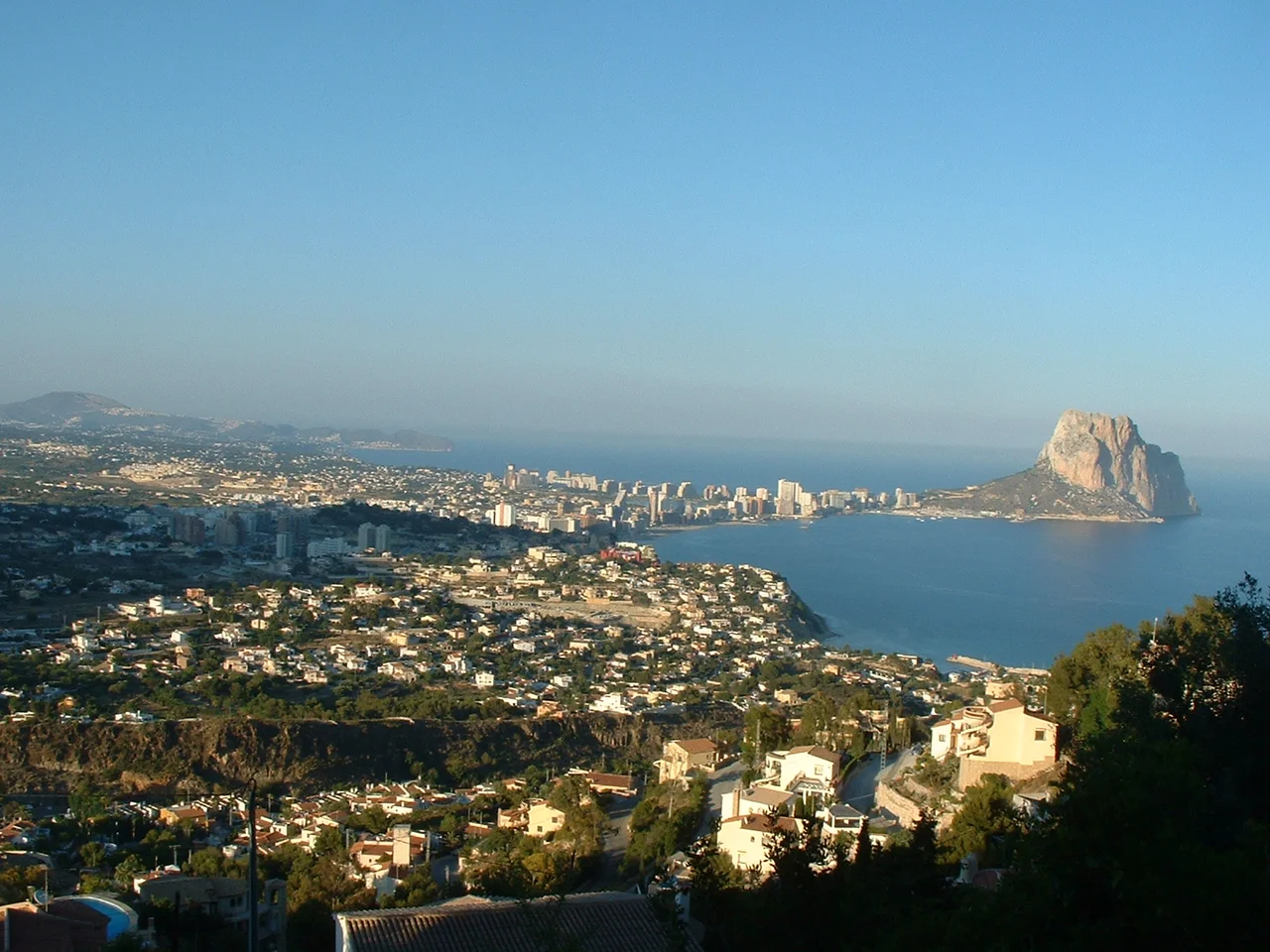

Calpe
The Romans came to Calpe for the fish. Along the shoreline they cut tanks straight into the rock, salting tuna and packing it for markets across their empire; the ruins still lie half-drowned at Els Banys de la Reina, the Queen's Baths, where the Mediterranean laps over stone two thousand years old. Calpe has always lived off the sea. It has also, for most of its history, lived in fear of what the sea might bring.
The Watchers on the Rock
Long before the Romans, Iberian settlers built on the high ground and kept watch from the great limestone rock that now bears the name Penyal d'Ifac. It was the perfect lookout, a sheer mass rising straight from the water and visible for miles in every direction. Inland, the Morro de Toix offered a second vantage, guarding the Mascarat Ravine, the narrow passage that any traveller along this coast had to thread. When Arab rulers took the region, they raised a castle above that ravine. Even after the Crown of Aragon conquered the area, the older order held: scattered settlements, each dependent for its safety on the Castle of Calpe. To live here was to know exactly where you would run when the horizon turned dangerous.
A Village Built and Burned
In 1290 the Aragonese admiral Roger of Lauria ordered a village raised near the rock and called it Ifach. It did not last. In 1359, during the War of the Two Peters, Peter IV of Aragon against Peter I of Castile, Ifach was destroyed, and its survivors crowded into the alqueria, from the Arabic al-qarya, the small town. These were humble buildings, one or two floors of plain stone set against the hillside. By 1386 the old district of the Castle of Calpe had been carved into the four towns still on the map today: Benissa, Teulada, Calpe, and Senija.
The Day the Corsairs Came
The sea's oldest threat arrived in 1637. Barbary corsairs out of Algiers fell on the Valencian coast and struck Calpe directly. When they sailed away, they carried 315 people with them into slavery, most of them women and children, taken from homes that had stood, until that morning, in the supposed safety of the shore. The raid left a wound the town answered with stone. Through the mid-eighteenth century Calpe laboured to throw a new fortified wall around itself, because by then its own growth had pushed too many families to live beyond the reach of the old defences. For a coastal town the sea was never only a livelihood; it was also the direction from which disaster reliably came, and Calpe built accordingly.
Salt, Fish, and Sunseekers
Peace, when it came, smelled of brine. Through the nineteenth century the fishing industry grew, and a Fisherman's Cooperative rose beside older salting factories. In 1918 the El Saladar salt flats were cleared and the salt pans worked again; today that same lagoon is a sanctuary where migratory birds, flamingos among them, stalk the shallows. The first small hotels appeared near the Queen's Baths and Raco beach, and in 1935 the Ifach Parador opened to summer visitors. Then, in the 1960s, came the great Costa Blanca building boom. For a few years around 1970 the town even doubled as a film set for the Spanish director Jesus Franco.
Zero Degrees
There is one more line that crosses Calpe, invisible and arbitrary and strangely fitting for a town so long obsessed with knowing its position. The Greenwich meridian, zero degrees longitude, the reference from which the world measures east and west, passes through the municipality on its way south. Wander the old centre and the deeper past is easier to see: a Gothic church, the eighteenth-century watchtower of La Peca, and always, over every rooftop, the pale bulk of the rock that has watched over all of it. Today Calpe is a resort of some twenty-seven thousand people whose economy still rests on the two things it always has, tourism and fishing, the trawlers unloading each afternoon at the port while visitors climb toward the summit. The town even keeps friends abroad, twinned with Oppenheim in Germany and El Puerto de Santa Maria in Andalusia.
From the Air
At 38.64 degrees north, 0.05 degrees east, Calpe sits at the foot of the Penyal d'Ifac, a 332-metre limestone rock that erupts from the sea and makes the town impossible to mistake from the air. Best viewed from 2,000 to 4,000 feet on a coast-following track, with the rock and the crescent bays to either side. Alicante-Elche (LEAL) lies about 60 km southwest; Ibiza (LEIB) sits offshore to the east across the water. Clear Mediterranean visibility is common, though summer afternoon haze can soften the coastline.
Nearby Stories
- Canelobre Cave 9.7 km away
- Monastery of the Corpus Christi (Llutxent) 12 km away
- Ciudad de la Luz 16 km away
- Cova Foradà 23 km away
- Es Vedrà 43 km away
- Cala d'Hort 57 km away
- Tabarca 59 km away
- Battle of Cape Cherchell 205 km away