.JPG)
Benicàssim
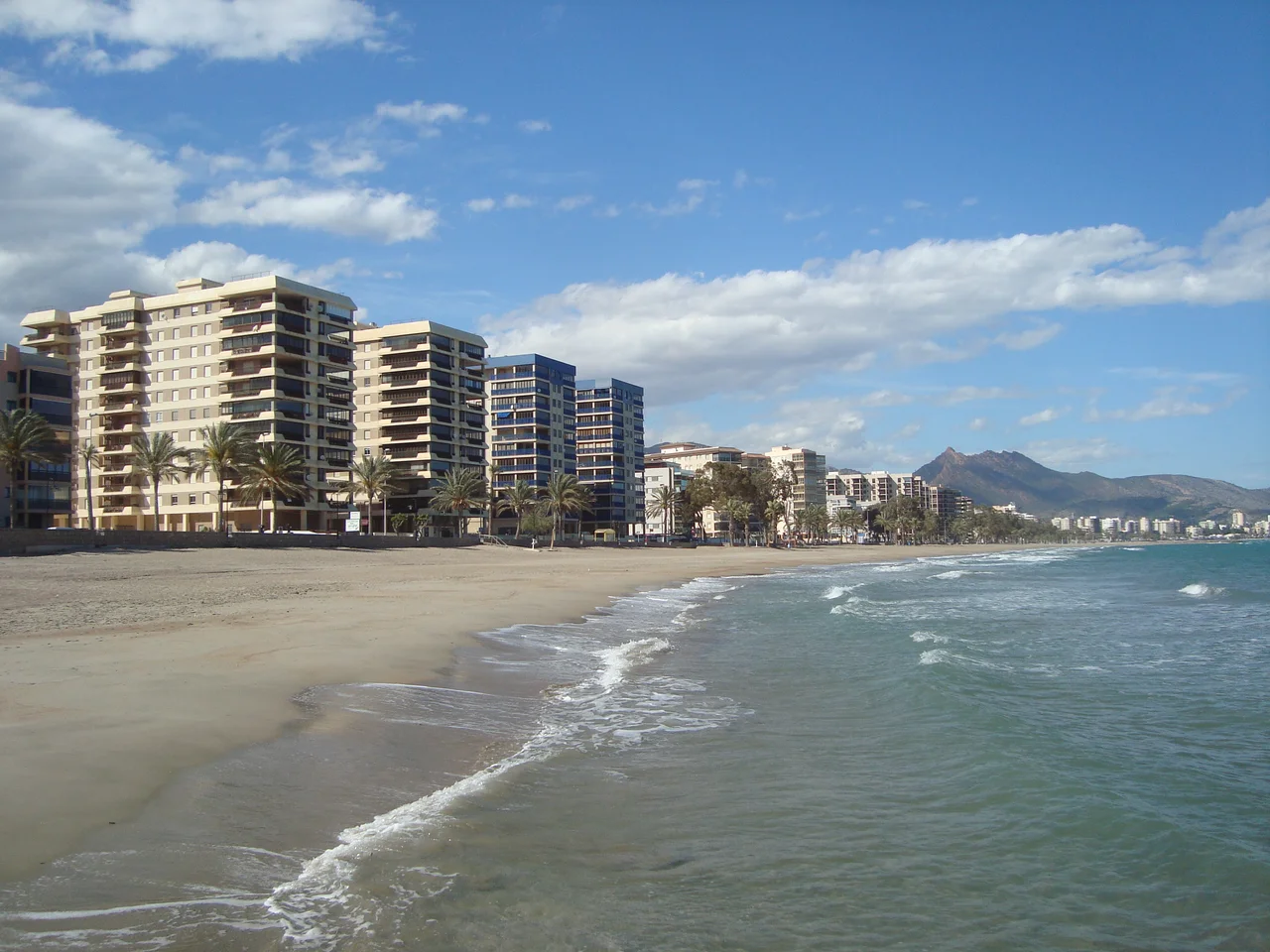
The wealthy families of Valencia and Castellón discovered Benicàssim in the second half of the 19th century, and they built accordingly. Along the seafront rose a parade of summer villas, turreted and tiled and half-hidden behind palms, where the region's merchant class came to escape the inland heat. More than a century later the same shoreline fills each July with a different crowd entirely: tens of thousands of music fans, tents pitched wall to wall, electric guitars where parasols once stood. Benicàssim has always been a place people travel to in summer. Only the summer people have changed.
A Parade of Summer Palaces
For a long time this was farmland and fishermen's cottages. When the English traveller Edward Hawke Locker painted the bay in the 1820s, he found a quiet coast with the mountains rising behind it. That changed as the century wore on and the moneyed families of the interior began building their eccentric seaside residences here, each competing to outdo its neighbour in towers, verandas and ornamental tilework. The district of Heliópolis grew from that fashion. Walking the older seafront today, you pass these belle-époque villas one after another, some restored and some faded, all of them evidence of a time when spending the summer by the Mediterranean was a mark of arrival.
In the Lee of the Palms
Geography made Benicàssim comfortable long before fashion made it desirable. The Desert de les Palmes range rises just inland, a green wall that blocks the cold north wind and leaves the town in a pocket of mild, sheltered air. The result is a run of gentle beaches, Els Terrers, Heliópolis and Torre Sant Vicent among them, the last named for an old coastal watchtower. The town sits about thirteen kilometres north of Castellón de la Plana, near the northern edge of the Valencian Community, and roughly twenty thousand people live here year-round. Tourism is the engine; the beaches are the fuel.
Where Radiohead Met the Guitar
Benicàssim's modern fame is musical. The Festival Internacional de Benicàssim, launched in the mid-1990s, has drawn a run of the biggest names in rock and electronic music to a town of this size, an outsized reputation for a place you can walk across in an afternoon. In the years since, the Rototom Sunsplash reggae festival has added a second summer wave of visitors. And in a quieter register, the town hosts the Francisco Tárrega classical guitar competition, honouring an instrument that Spain gave the world. Few places manage to be a pilgrimage site for both festival crowds and concert-hall purists.
Sons of a Forgotten Family
The name itself is a fragment of older history. Benicàssim begins with the Arabic beni, meaning "sons of," the same root that marks town names all across the former al-Andalus. It is a reminder that this coast was Muslim territory for centuries, its farms watered by techniques the newcomers had brought from the east. Above the town stand the ruins of a medieval castle, worn down to stubs of wall, marking the era when control of the shoreline meant survival. The summer villas and the festival stages are only the most recent layer on a beach that people have valued, and fought over, for a very long time.
A Town Built for Summer
Strip away the villas and the festivals and what remains is a straightforward Mediterranean resort, and a successful one. Roughly twenty thousand people live in Benicàssim through the year, but the number swells across July and August as holidaymakers fill the apartments and campsites and spread along the beaches. Tourism is the town's economy, plainly and openly; the seafront, the sheltered water and the reliable sun are the products it sells. What gives the place its particular flavour is the overlap of its two summer traditions. The families who take their annual fortnight by the sea and the young crowds who come for the all-night stages are, in the end, doing what this town's 19th-century visitors once did from the balconies of those ornamented villas, escaping the heat of the interior for the cooler edge of the Mediterranean. Benicàssim has simply been perfecting the art of the summer holiday for well over a century.
From the Air
Benicàssim lies at 40.055°N, 0.064°E on the Costa del Azahar, roughly 13 km north of Castellón. From 3,000-5,000 feet the town reads as a band of low development between a long straight beach and the abrupt green ridge of the Desert de les Palmes immediately inland, the clearest navigation cue in the area. Castellón-Costa Azahar (LECN) is the nearest field, just to the south; Valencia (LEVC) lies down the coast to the southwest and Reus (LERS) up the coast to the northeast. Summer haze is common along this shore; clear mornings give the sharpest view of the mountains meeting the sea.
Nearby Stories
- Alcalà de Xivert 7 km away
- Llíria 24 km away
- Vía Verde de Ojos Negros 31 km away
- Battle of Saguntum 38 km away
- Delta de l'Ebre Natural Park 49 km away
- Teruel 62 km away
- Battle of Ebro River 82 km away
- Illa Conillera 94 km away