
Andratx
The mountains do not end at Andratx so much as dive. The Serra de Tramuntana, Mallorca's rugged spine, runs the length of the island's northwest coast, and at this southwestern tip it plunges straight into the Mediterranean. It surfaces once more as the serrated island of Sa Dragonera, then slips beneath the waves for good, continuing underwater all the way to Ibiza. Andratx — locals say it roughly as 'Andratsh' — sits at that hinge point, a town of some 11,800 people spread between an inland old quarter, a yacht-filled harbour, and a string of coves where the rock never quite softens into sand.
A Town That Learned to Hide
Like most old settlements on Mallorca, the original village kept its distance from the water. Corsairs and raiders made the open coast dangerous, so Andratx grew several kilometres inland, tucked into the hills, while a small, defensible port handled what trade there was. The Romans knew the place as Andrachium and left behind a handful of coins and pottery shards — but no temples, no aqueducts, nothing grand. For centuries the living here was thin: subsistence farming on terraced slopes, fishing from the sheltered inlets, and little else. Poor roads and a shortage of good harbours kept the wider world at arm's length, which is more or less how the villagers preferred it.
The Tourists Found Only One Beach
When Mallorca's tourism boom arrived in the late twentieth century, Andratx had a problem: almost none of its coastline was sandy. The rugged shore that had once deterred pirates now deterred the package-holiday crowd, who wanted a beach to lie on. Only Camp de Mar offered a genuine stretch of sand, so that is where the big hotels rose. Everywhere else took a quieter path. Port d'Andratx and the little resort of Sant Elm filled instead with holiday homes for prosperous mainlanders; yachts crowd the marina's south side by the old harbour, while the larger craft — what one guide cheerfully calls the floating gin palaces — moor to the north. The hills above remain nearly empty.
The Dragon's Reprieve
Just offshore lies Sa Dragonera, an uninhabited sliver of an island four kilometres long and barely half a kilometre wide. Its serrated ridgeline gave it the name — the dragon's back — and today it is a nature reserve, home to thousands of lizards that scatter across the warm stone. It nearly became something else entirely. In 1974 a developer set out to cover it in a tourist resort and spent the next decade fighting for the right to do so. He lost. In hindsight the defeat may have spared him a far worse financial wound, and it certainly spared the island. The little harbour at Sant Elm shelters behind the islet of Pantaleu, and from its waterfront the dragon-island fills the horizon, close enough to reach by kayak or by the small boats that ferry visitors across to walk its single spine of a trail.
Monks, Mills, and Dry Stone
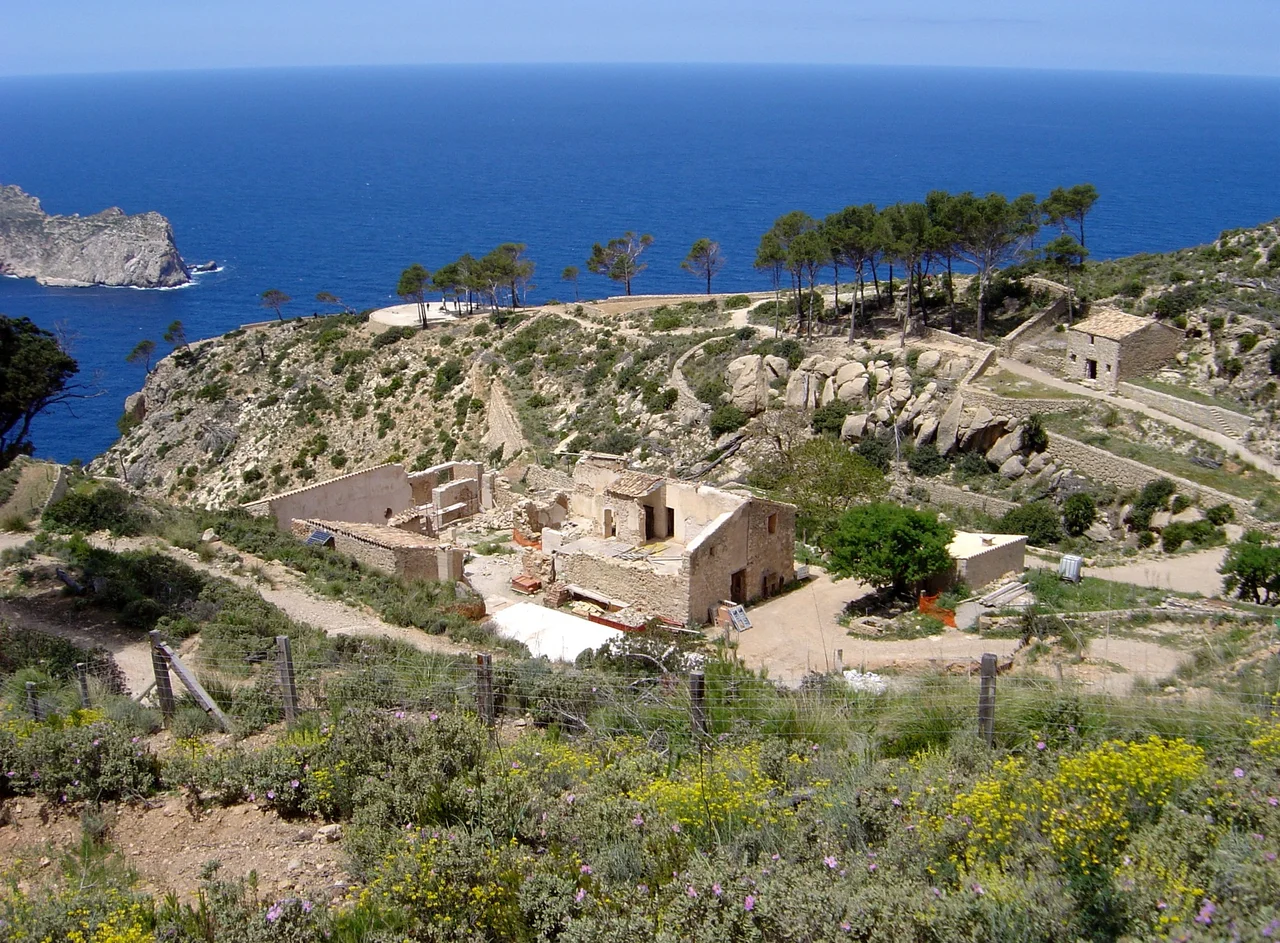
The hills around Andratx are stitched with human effort. A windmill built in 1784 still stands on the ridge north of town. On a hilltop above, the Castell de Son Mas dates to the sixteenth century, though its Gothic-and-Arabesque flourishes are a twentieth-century reinvention; it now serves as the town hall. Down in the old town, the church of Santa Maria d'Andratx traces its founding to 1248, though the building you see today is an eighteenth-century successor, while in the port Nuestra Señora del Carmen was consecrated in 1918. Four kilometres north of Sant Elm, the roofless shell of La Trapa remembers a stranger story: Trappist monks settled there in 1810, refugees from the anti-clerical fervour of Revolutionary France, and farmed the steep land until they abandoned it around the middle of the twentieth century. From Port d'Andratx begins the GR 221, the 'Route of the Dry Stone Walls,' which threads nine stages along the coast and through the Tramuntana to Pollença. On 12 August 2026, if the sky cooperates, this coast will also fall under the shadow of a total solar eclipse at sunset.
From the Air
Andratx lies at 39.575°N, 2.421°E, at the southwestern tip of Mallorca. Approaching from Palma de Mallorca (LEPA), roughly 30 km east, follow the coast west past the resorts of Calvià. The unmistakable landmark is the serrated island of Sa Dragonera off the point, with the natural harbour of Port d'Andratx tucked into the cliffs just east of it. A viewing altitude of 2,500-4,000 ft AGL gives the best sense of how the Serra de Tramuntana drops into the sea here. The rugged coast is usually clear, but afternoon sea breezes and summer haze can soften the horizon.
Nearby Stories
- Jewish quarter of Inca 13 km away
- Bocchoris (city) 23 km away
- Portinatx 36 km away
- Cala de Sant Vicent 64 km away
- Illa de Tagomago 67 km away
- Miquel Capllonch Rotger 68 km away
- Battle of Ebro River 118 km away
- Notre-Dame d'Afrique 287 km away